Key Takeaway:
A high yield savings account earns more interest than a traditional savings account and is a safe, low-risk way to grow your money—especially for emergency funds or short-term goals.
If your money is just sitting in a regular savings account, it’s probably not doing much for you. In fact, it might be losing value over time thanks to inflation. But there’s a smarter way to put your cash to work.
A high-yield savings account is a bank account that will typically pay a higher interest rate than a standard savings account. It allows your money to grow faster through the power of compound interest, making it a great option for building an emergency fund, saving for short-term goals, or simply earning more from your cash reserves.
The difference in interest rates can be radical. Top high-yield savings accounts can, at times, offer rates more than 10 times the average savings interest rate. That means your savings grow more, and faster, just by choosing the right place to keep them.
Pros of High-Yield Savings Account
High-yield savings accounts are great for many reasons. The most significant benefit is that you can receive a greater return on your investment while enjoying access to your money if you need it. High-yield accounts offer a higher yield, hence the name, on the money that is in your account. Money that would normally be stagnant in value (or lose value in periods of high inflation) can gain value if placed in the right account.
Higher APY
High-yield savings accounts often offer a higher APY (annual percent yield) than other deposit accounts. The higher the APY, the faster your money will grow, which provides you with a larger return in the same amount of time.
Low Risk
High-yield savings accounts are a safe, stable place to grow your money without the uncertainty of market swings. Unlike stocks or mutual funds, your savings aren’t directly exposed to the ups and downs of the market, which means you won’t lose your principal due to volatility. And unlike CDs, you’re not locked in for a specific time period, giving you access to your money without early withdrawal penalties.
Lower Fees
High-yield savings accounts are often offered by online banks. Because they have lower overhead expenses, these banks typically do not charge fees or charge much lower fees than traditional brick-and-mortar banks. Depending on your needs and use of the account, reduced or eliminated fees could result in significant cost savings for you.
FDIC or NCUA Insurance
Deposits in high-yield savings accounts are typically insured up to $250,000 per depositor, per institution by the Federal Deposit Insurance Corporation (FDIC) or National Credit Union Administration (NCUA), offering peace of mind that your money is protected, even if the bank faces issues.
Flexible Access to Funds
Checking accounts can also be linked to high-yield savings accounts to make money transfers that much easier. This allows you to transfer money in and out as needed, making them ideal for emergency funds or short-term savings goals.
At TAB Bank, we make it easy to start saving smarter. To get the best value out of our high yield savings accounts, pair yourTAB Save account with aTAB Spend rewards checking account. You’ll earn interest on your savings plus 2.75% APY on your checking balance (as of May 3, 2026) and up to 1.00% cash back on everyday purchases. With seamless transfers between accounts and instant access to your funds, you don’t have to choose between growing your money and having it ready when you need it.
Cons of High-Yield Savings Accounts
While high-yield accounts offer greater returns, they may not be a fit for every need. Depending on the purpose of your account and what you plan to do with the money in your account, some of these cons are less applicable. However, they are valuable to keep in mind when deciding whether a high-yield account is right for you.
Harder to Spend
High-yield savings accounts may require you to withdraw or transfer your money in order to spend it. While there is no longer a federal regulation limiting the number of transfers or withdrawals each month, high-yield savings accounts typically do not provide check books or debit cards for making purchases. If you want to enjoy the benefits of a high-yield savings account while enjoying more payment options, it is best to use one in tandem with a checking account. That will allow you to periodically transfer money from your savings account to your checking account for easy and convenient spending.
At TAB Bank, our TAB Save accounts and TAB Spend accounts are designed to work seamlessly together. By pairing these accounts together, you can earn even more from the money you spend on daily purchases and transactions.
Changing APY Rates
The APY rate for high-yield saving accounts are not set in stone. The interest rates can increase or decrease at any time, though adjustments are typically not a daily or even weekly occurrence. Rate changes are based on several monetary and economic factors, and thus their frequency can be difficult to anticipate. The fluctuation in rates is often correlated to actions of the Federal Reserve. As its federal fund’s rate changes, bank and credit union APYs around the country may follow suit.
Fees or Minimums
While some banks have fees on their high-yield savings accounts that eat into your money’s growth, TAB Save accounts don’t charge monthly maintenance fees and don’t require a minimum balance to open. If you’re comparing options, be sure to look closely at the fine print, and understand fully how fees or minimums might impact your ability to save.
Best Uses For High-Yield Savings Accounts
High-yield savings accounts are especially valuable when you need a place to grow your money while still keeping it accessible. Here’s how they can support some of the most common financial goals:
Emergency Funds
During an economic crisis, having an emergency fund may be the only thing that sees you through. If you have savings or a lump sum of money, a HYSA is one of the best places to store your emergency fund. It earns higher interest than a regular savings account, helping your safety net grow over time. And because funds are typically accessible via online transfer or linked checking accounts, you can quickly access the money when unexpected expenses, like medical bills or car repairs, arise.
Saving for a Down Payment
Whether you’re buying a home or a car, a HYSA allows your savings to grow while you work toward your target amount. Unlike a certificate of deposit (CD), you can add funds to a high-yield saving account over time and access them without penalties when you’re ready to make your purchase.
Travel or Vacation Fund
A HYSA helps you stay disciplined about travel savings. You can schedule automatic transfers into the account and watch your money grow with interest. Since HYSAs don’t offer easy debit access, they reduce the temptation to spend prematurely, but your funds remain available when it’s time to book.
Short-Term Goals
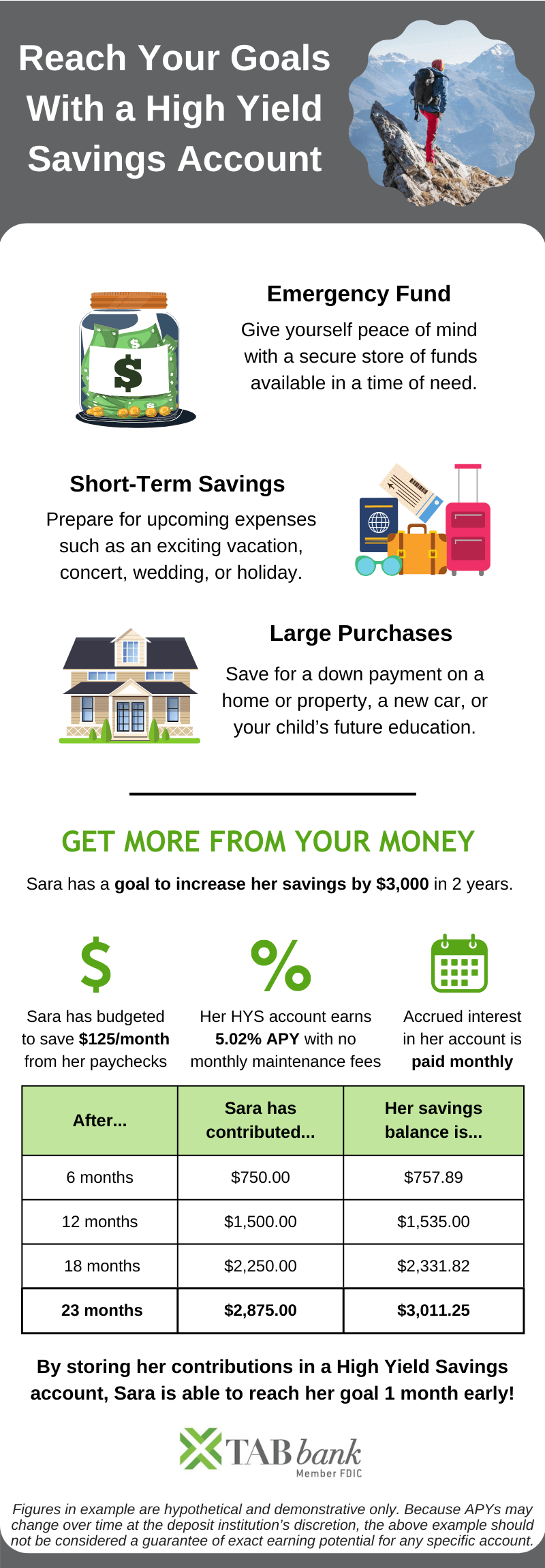
For goals 6–24 months out, a HYSA strikes the right balance between safety, growth, and access. Your money earns more interest than it would in a checking or regular savings account, and you avoid the market risk of investing. Plus, you can track your progress toward your goal as your balance and interest compound.
How to Find the Best High-Yield Savings Account
While APY is an important factor in choosing a high-yield savings account, there are numerous other factors to consider as well. TAB Bank has put together a list of consideration factors to help you choose the best savings account for you.
• Fees – Paying substantial fees for your banking service can significantly reduce the profit that comes from interest earnings. Look for banks, like TAB, that don’t have monthly fees for maintenance or other unneeded services.
• Monthly Requirements – Many banks will require you to meet a monthly requirement to actually earn interest on your savings. The interest rates may also differ depending on how much money you have in your savings account. Make sure you read the fine print before assuming all perks apply to you. Double-check that you meet the requirements or find a bank with less strict qualifications.
• Convenience – The best interest rates are normally found at online banks. This is a great place to look, but ensure you know how to access funds when you need them.
• Customer service – This is a factor that is often overlooked but is one of the most important. Look for a variety of ways to contact the bank. The best banks will offer multiple services including online banking, email, and phone.
• Know the standard – According to the FDIC, the national average savings account in November 2025 paid 0.40 APY with large banks often offering lower than that. Know what you are comparing to in order to ensure you get the best deal.
The Difference Between High Yield Savings Accounts & Other Bank Accounts
| Account Type | Interest Earned | Access to Funds | Best For | Other Notes |
| High-Yield Savings | High (variable, often 10–20x higher) | Easy access via online/mobile transfers | Emergency funds, short-term savings goals | FDIC insured; no fixed term |
| Traditional Savings | Low (around 0.45% APY or less) | Easy access in-branch or online | Basic saving, linked to checking | Usually offered by brick-and-mortar banks |
| Traditional Checking Account | Very low or none | Immediate access (debit card, checks) | Everyday spending, bill payments | May offer cashback; typically earns no interest |
| TAB Spend Rewards Checking Account | Moderate (can be similar to HYSA) | Immediate access (debit card, checks on request) | Everyday spending, bill payments | [1] Cash back on purchases, early direct deposit, no fees |
| Money Market Account | Moderate (can be similar to HYSA) | Checkbook access, limited ATM use | Saving with some spending flexibility | Often requires higher minimum balance |
| Certificate of Deposit | Higher (fixed for the term) | Locked in until maturity (penalty to withdraw) | Saving for a known date in the future | Fixed term; not ideal for emergency access |
TAB Bank High-Yield Savings Accounts
At TAB Bank, we make it easy to start saving smarter. Our TAB Save accounts come with no monthly maintenance fees, no minimum balance to open, and no hidden service charges, just competitive rates and daily compounding interest that helps your money grow from day one. With FDIC insurance for added peace of mind and a powerful online banking app to keep you in control, you can feel confident knowing your savings are secure, accessible, and working harder for you.
FAQ
Is a high-yield savings account a good idea?
A high-yield savings account is an excellent strategy if you are looking to open or switch savings accounts as the money will grow faster than it would in a normal savings account due to having a higher APY. If you are looking to grow your long-term wealth, consider pairing your high-yield savings account with another investment strategy as sometimes the rate of inflation can surpass the APY of your account.
What’s the downside of a high-yield savings account?
Previously, the biggest downside with high-yield savings accounts (like other savings accounts) is that money would be less accessible than a checking account due to the 6-withdrawal limit. However, that governing regulation was suspended during the COVID-19 pandemic and is no longer a concern. At TAB Bank you get to enjoy the benefits of a high-yield savings account without any restriction on frequency of access.
How does an online savings account work?
Some online savings accounts have to be connected to a checking account for easier withdrawal of money. This means that it can be harder to access your cash, which may be good or bad depending on your intended use of the funds in your account. Many find it beneficial that their money is harder to access if they are trying to grow their savings, but it can be inconvenient in cases where an emergency withdrawal is needed. Before opening an account, you should learn what methods are available for accessing your money, and how long each would take.
Can you lose money with a high-yield savings account?
As long as you open your account at an FDIC-insured* bank, you face no risk of losing the principal balance. Interest and APY rates can change, which will affect the return you receive, but you will not find yourself losing money from a high-yield savings account.
Do you pay taxes on a high-yield savings account?
Any interest earned from a high-yield savings account will be taxed as ordinary income. You must report any and all interest that you receive when you file your annual tax return, but you will not have to pay taxes on the interest you earned if it is less than $10. Interest over $10 may be taxable.
How much money does a high-yield savings account make?
The amount of money a high-yield savings account makes is determined by the amount of money you add or withdraw, APY rates and adjustments, frequency of compounding, and other factors such as account fees, which can vary by institution. You should consider and compare as many of these elements as possible when deciding whether or where to open a high-yield savings account.
Disclaimers:
* The FDIC insures up to $250,000 per depositor, per account category, per institution. Any dollar amount above $250,000 per depositor, per account category, per institution is not insured. Learn more.